After a long 18-month wait, I was finally able to fly back to Finland in June 2021. This trip felt a bit special after such a long wait: I normally go to Finland a few times a year.
I decided to make the most of it and bring back some sauna stuff. Almost everything can be ordered online but sauna accessories are marked up quite a lot here.
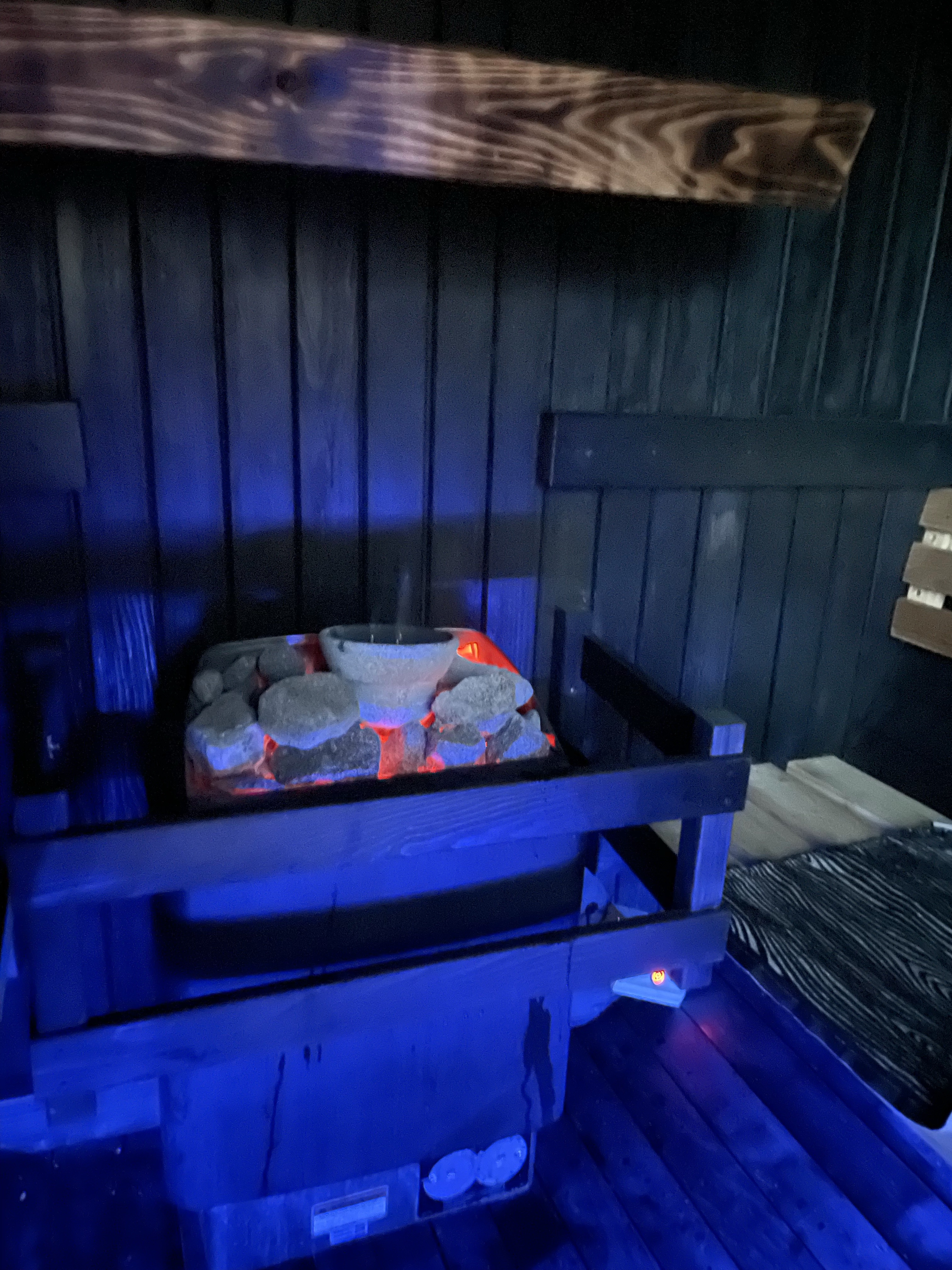
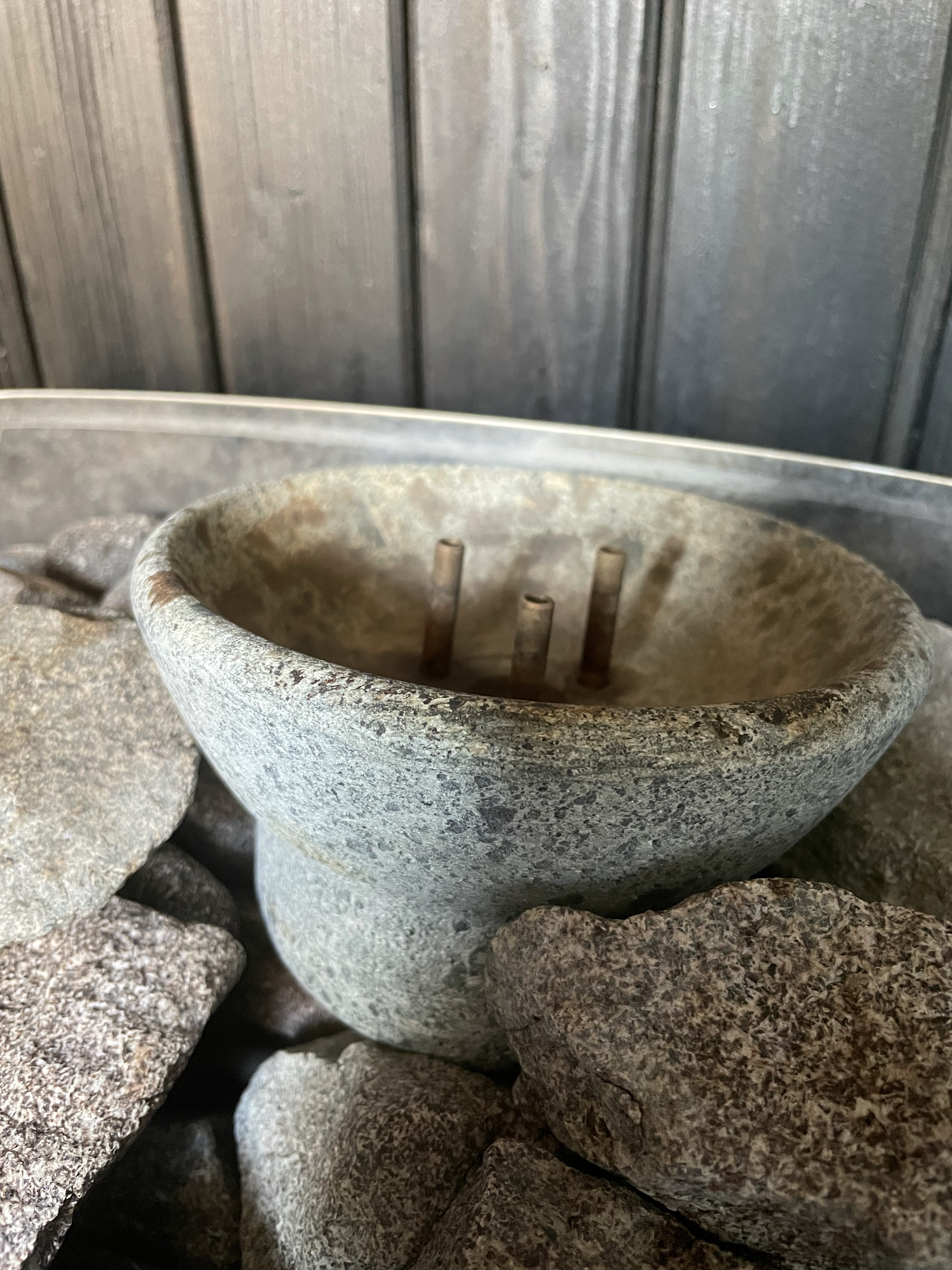
Just because everything works a bit differently in barrel sauna when it comes to steam, I wanted to try something I had in Finland a long time ago: a sauna fountain. The literal Finnish translation is “sauna genie” (think Alladin) but it seems that the international translation goes “Sauna Maestro”. Sauna genie would have been much better.
Anyway, this bowl is made of soap stone. You simply put it on the stove and let it heat up. Then when you start saunaing, you simply pour it full of water. At first the water evaporates just like when you pour water on regular sauna stones creating a nice steam. When you keep adding water, the bowl will cool down a bit and starts spitting the water out of the pipes on the stove. So, it’s almost steam automation.
Nice stuff but do I like it? I can’t tell, so let’s dust my precisely calibrated equipment and review this thing scientifically.
This kind of a two-deciliter bowl (one cup) is quite big for my 3.5 m3 sauna so my hypothesis was that this could affect the steam. As you remember from my About Sauna Temperature and Humidity blog post from May, the absolute humidity went from 10 g/m3 to about 40g/m3. The difference is that when I’ve tried this device in summer time, the the starting humidity is very different. Now in summertime, it seems that the absolute humidity is quite often in the 50’s if I go to the sauna when it’s 70c and in the 40’s when I go there a bit earlier.
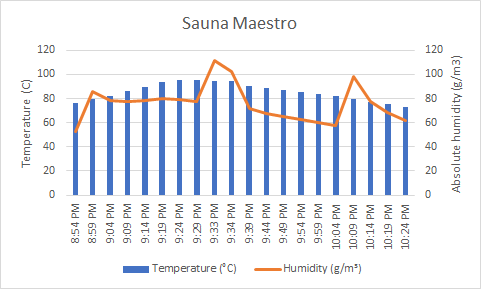
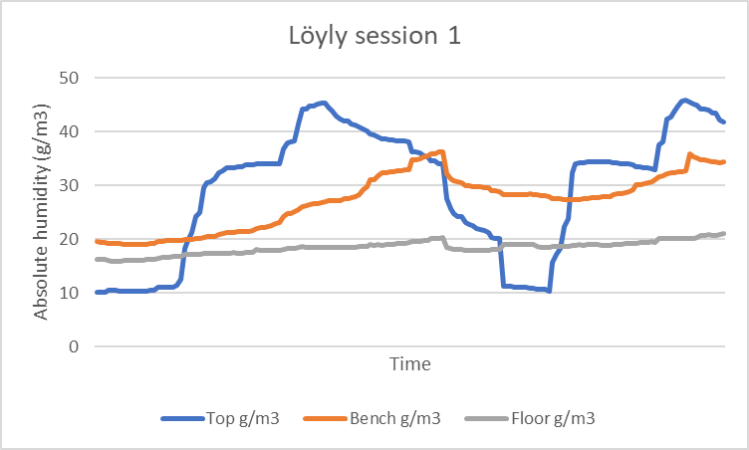
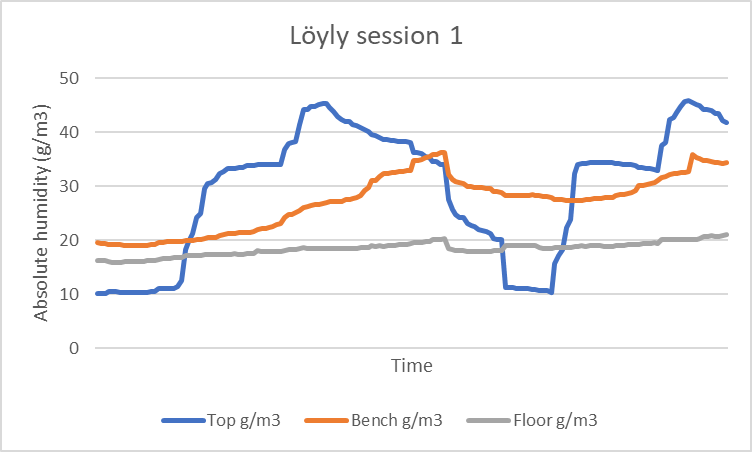
Below is one example of my summer sessions: I went in at around 8:55PM and spent 90 minutes including quite long breaks. I had three more intense sessions that you can see in the humidity line. You can see that on the first round, the humidity increased by about 40 g/m3 which is a bit bigger increase that I have seen before installing Sauna Maestro. The second graph with title Löyly session 1 shows how the humidity increased by about 35g in the first session, 25g in the second session and 15g in the third session. Then again with Sauna maestro, you see about 40g in the first session, 30g in the second and 40 in the third one. This supports my anecdotal feelings as well that the gadget helps to increase humidity more in the second and third session. I must admit though that 95c and 110 g/m3 steam was a bit too much for me in my small sauna.
In other sessions earlier this summer, I have tried the limits of the stove. Once I reached 100.31C temperature and shut down the stove because I thought my thermometer cannot take that temperature for very long. I filled the Maestro and got the humidity to 116 g/m3. That translated to only about 20% relative humidity but keep in mind that the dew point then was 60c so basically all surfaces less that 60 degrees hot including my body condensed steam to water like crazy. Interesting feeling all in all.
Is it worth it?
Sauna Maestro seems to cost $70 in the U.S. before shipping and tax. It costs about 30 euros in Finland so you pay a bit of a premium here. It looks nice and makes a nice hissing sound. It probably won’t transform the sauna experience in one way or another but I feel it add nice “background” löyly in the room at least in my small sauna. I then also pour water on the regular stones, of course.
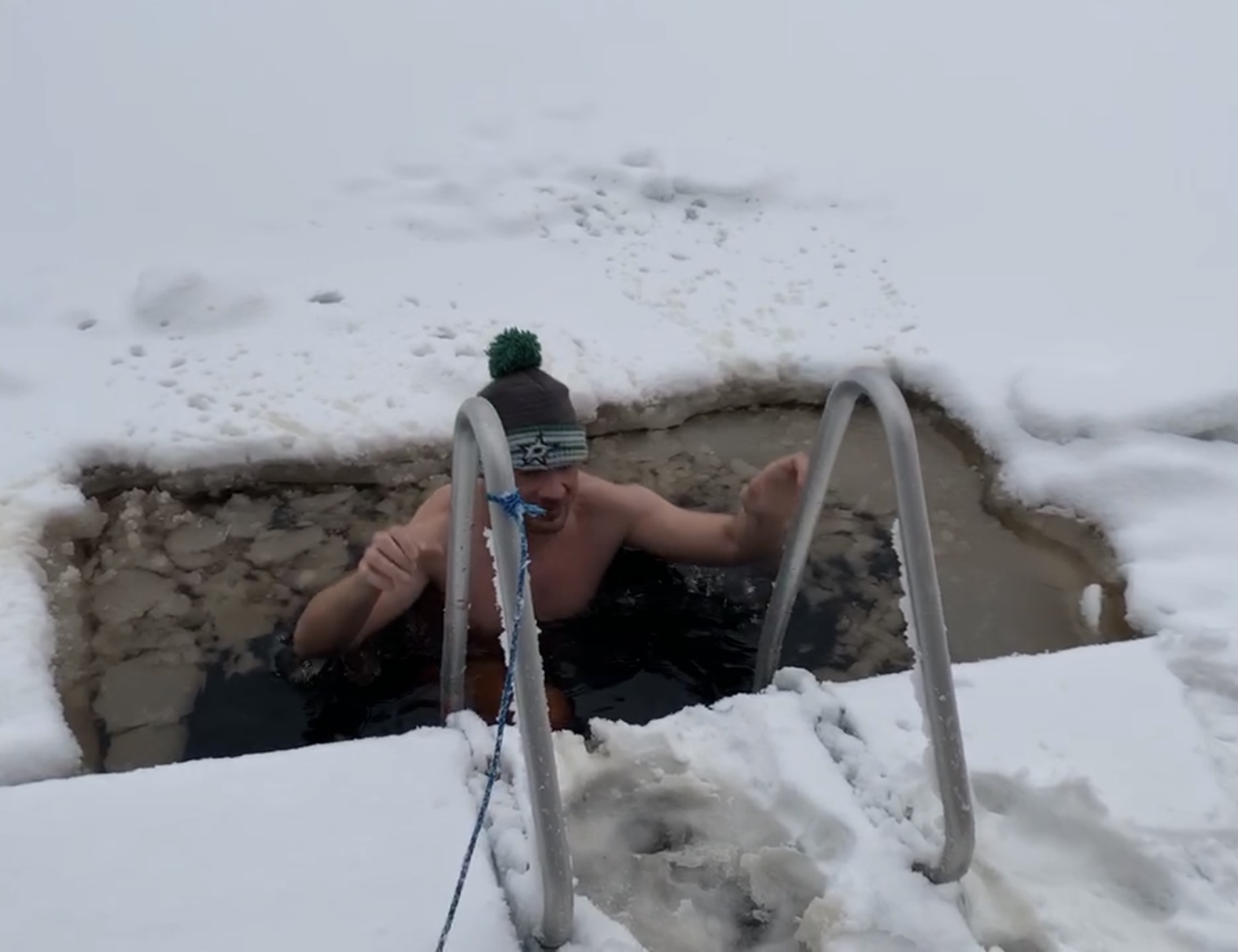
I always like to associate winter sauna with ice swimming (polar plunge in the U.S.).
There are some published studies on the subject of health benefits of jumping to a frozen lake. Some studies suggest that the body produces more adrealine which then gives you that euphoric feeling of accomplishment. Other studies suggest that cold plunge improves the elasticity of the veins and and exercises the heart. Especially if you go from hot sauna to a cold water you subject your system to two extremes: in a hot sauna, your veins expand because of the heat and your blood pressure drops, your heart rate goes up to maintain the blood pressure so that you won’t faint. When you then jump to a cold water, the opposite happens: veins shrink and blood pressure increases. All good exercise but take a small break in between the two extremes and think twice if you have cardiovascular conditions.
As for the recovery effect, many pro athletes take ice baths to recover so maybe that works. I still didn’t make it to the Tokyo Olympics so this might be individual.
In the absence of a lake and temperatures that would actually make the lake freeze, I just have to improvise. Internet is full of great ideas for cold plunge ranging from purpose build freezer-looking tanks that go for $5,000 to people using their old chest type freezers to anything and anywhere in between.
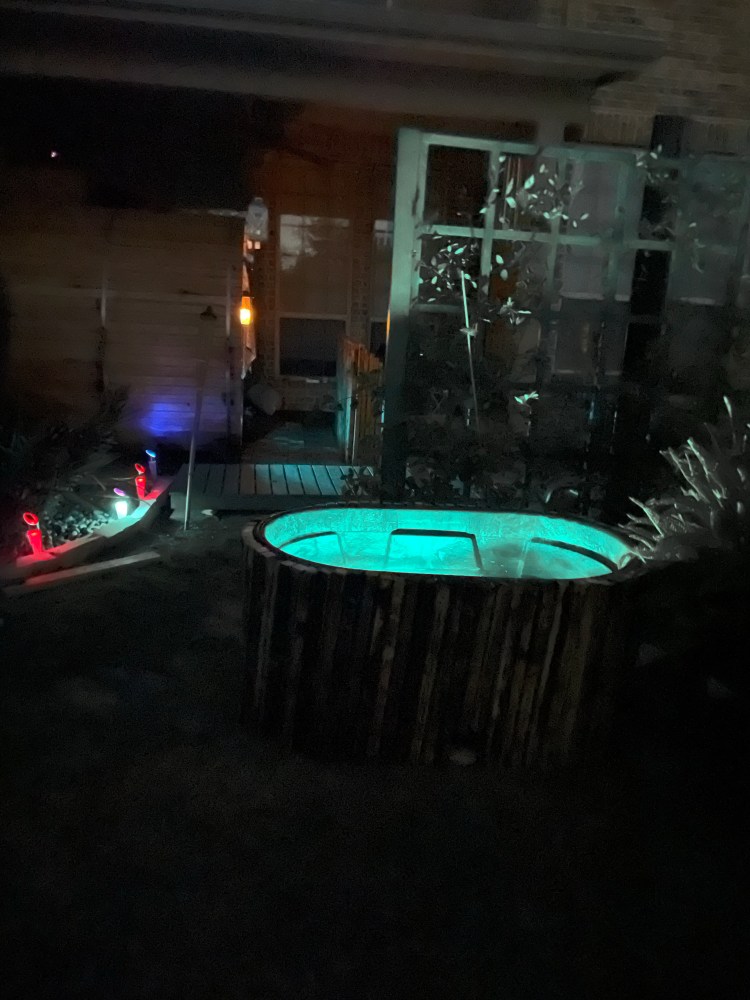
I decided to go an inexpensive route for this one and just got a 100-gallon plastic stock tank from a hardware store ($100). Then I happened to have some 2×2 trims left from my previous amazing projects so I made a cover around the plunge to make it look less cheap :). Finally, I dropped a submersible led light on the bottom to add nice hue.
Using this plunge is pretty much as easy as you would probably think: fill it with garden hose, throw a few bags of ice if you like,and use it. I usually use the water for the plants the next day so nothing goes in waste.
My goal was to be able to do a routine of sauna –> cold plunge –> hot tub —> rinse –> sauna in the colder season and that’s what I got.
Finns like their summer places and villas. They call them summer cottages or summer cabins (kesämökki), or just cabins if the place can ve used during cold winter months. There are about 500,000 such places in the country of 175,000 lakes and 5.6 million people.
Some of these cabins are fancier with all amenities whereas some won’t have running water or electricity. The average size is only about 50m2 (500 sq ft) but some places are obviously bigger. However, it is safe to say that all these cabins feature at least one sauna. Typically the sauna is in a separate building by the lake and has a wood-fired stove. About 75% of these lakehouses are connected to the grid but only about 15% of them have a running water and a sewer so the drinking water is often brought in canisters (50% of cases). This as such sets certain requirements for saunas too. A wood-fired stove with a connected water heater is often the only viable combo.
This blog introduces one such place and talks a bit about sauna and cabin culture in Finland. After all, when Finns are asked what they did at their summer cabin during their vacation, most say that they saunaed a lot.
Firewood
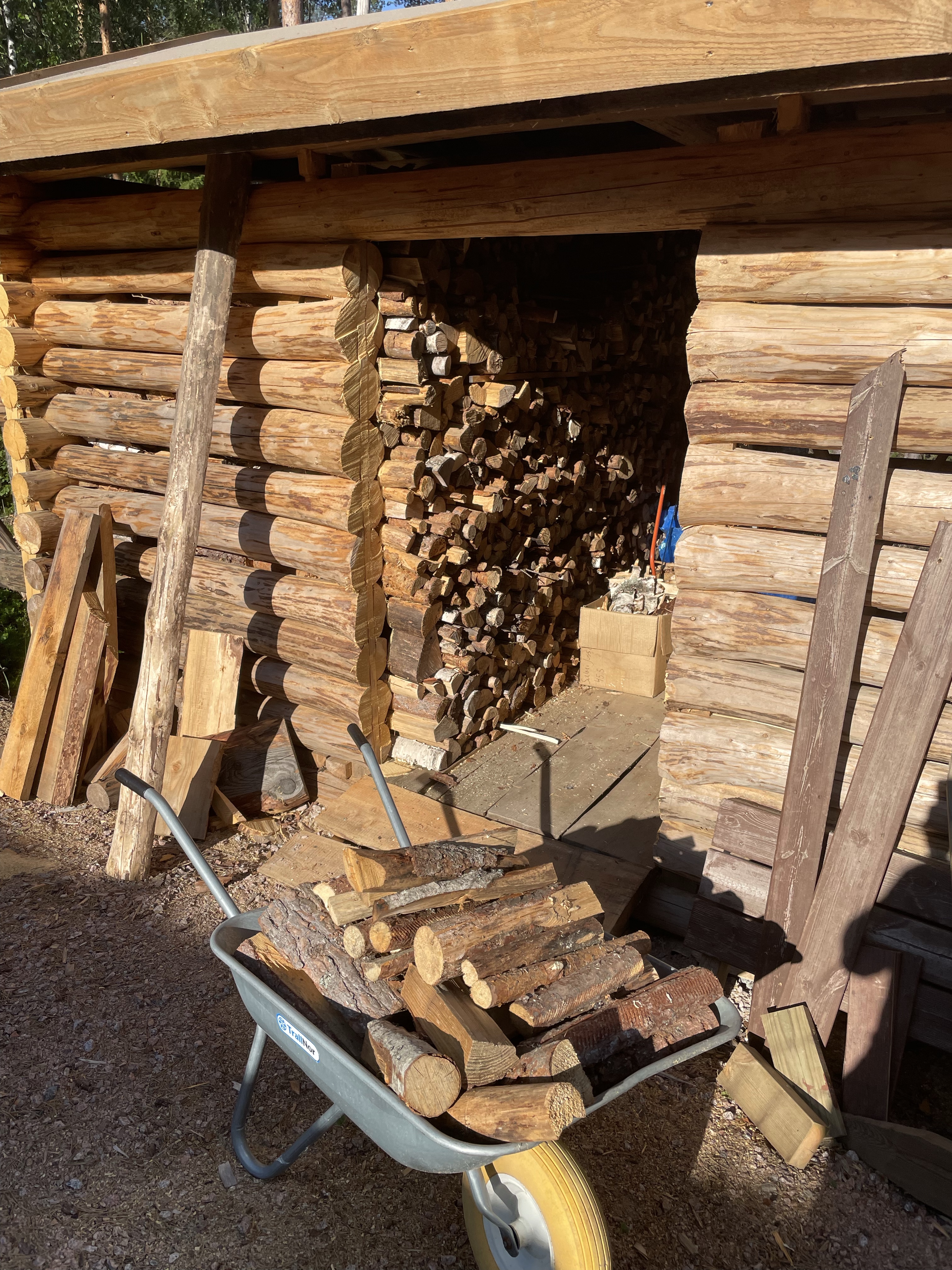
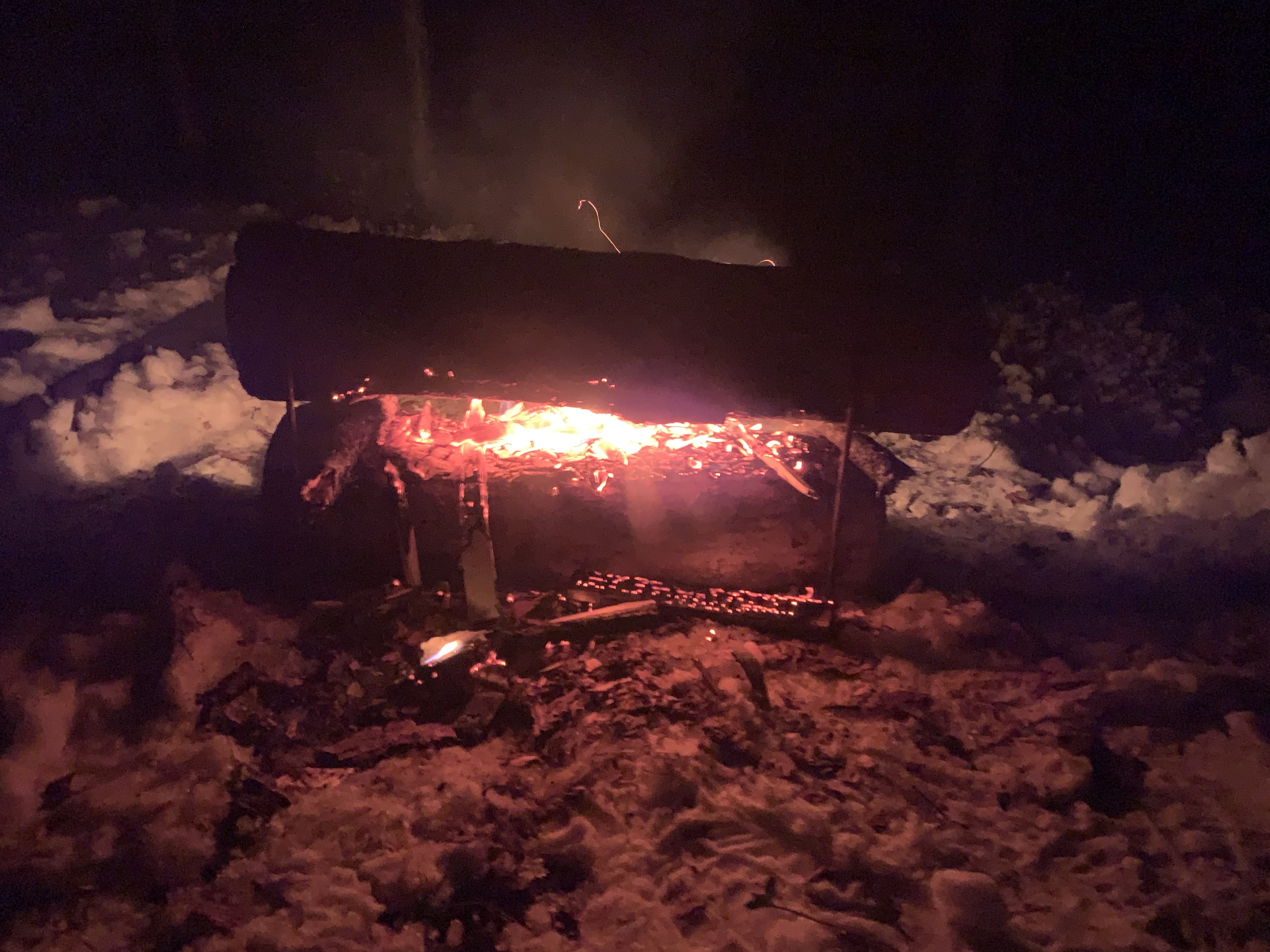
Chopping firewood is one of the popular chores at a summer place. There’s always something to do: harvesting the forest, cutting logs, chopping firewood, drying it, you name it. There are many uses for this firewood. You typically use birch for heating a fireplace because it provides more energy and doesn’t have resin (doesn’t crackle). Pine and spruce can be burned as well and they make great sauna firewood for summer when you don’t necessarily need all that heating energy. Then you obviously cook on fire or make lumberjack’s candles (often translated as Swedish torch, what a shame) or nying (rakovalkea in Finnish).
Cabin saunas
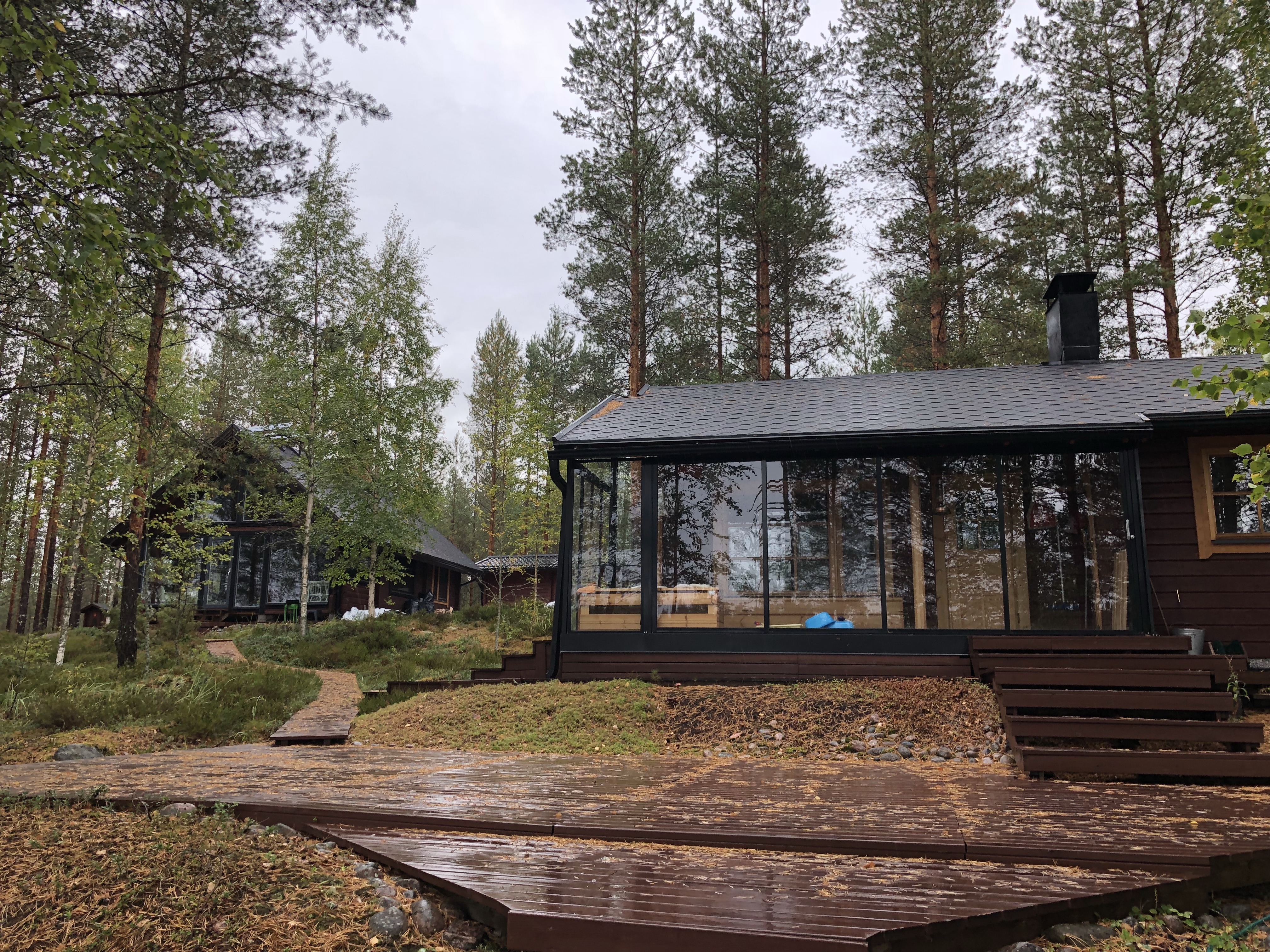
It is quite common that saunas at these summer places are built in separate buildings. This is partly because you were often allowed to build a sauna building closer to a lake but had to build the main building a litte bit further up the hill. Needless to say, some saunas like this one here has amazing location and view to the lake.
Another thing you’ll notice that the seats are almost always about 4-5 feet from the ceiling so your head will be close to the ceiling. This is because ideally you should keep your feet at the level or the top of the heater or above. Also, the hot steam goes up in the sauna so you want to keep your upper body as close to the ceiling as possible. I’ve seen many 8 ft high saunas in the U.S where the feet are kept on the floor and you have easily more than 4ft space above your head. That is waste if space: always build the seat as high up as you can for perfect löyly.
Shower and Other Amenities
The most common way to shower in these saunas is to dip in a lake. In winter you have to get an ice saw to make a hole through the ice. Chainsaw is handy for this job too.
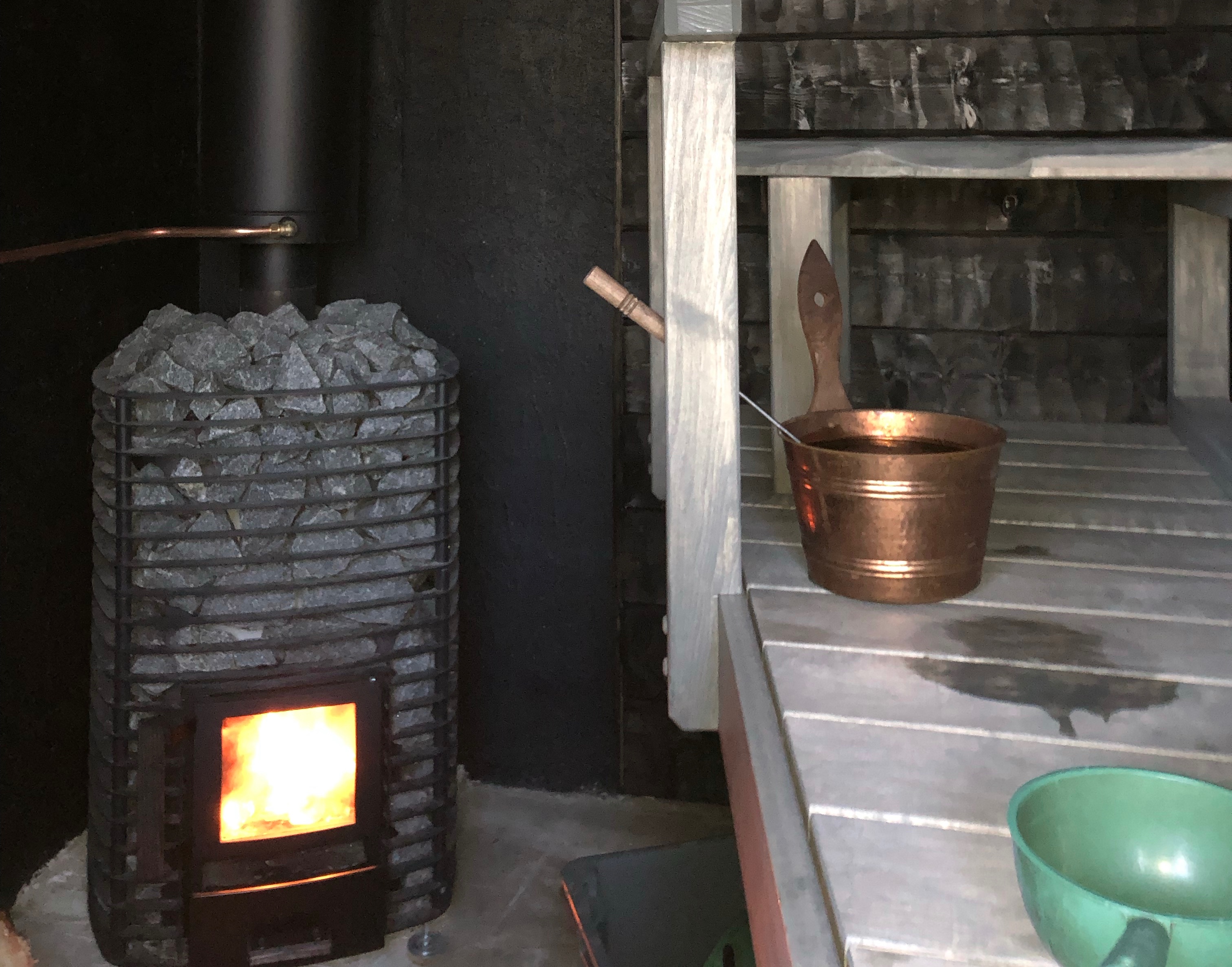
Most saunas also have a water heater attached to the stove. You bring cold water from the lake or from a well to the sauna and mix it with boiling water to rinse after the sauna.
Lake water is not good to pour on the stones because it tends to smell and make the room dirty so always use either drinking water, raining water, water from a well or melt the water from snow. Generally speaking, the warmer the löyly water, the better: ice-cold water cools down the rocks pretty easy. I always place the löyly bucket on the seat whenI start heating up the sauna.
Temperature and Construction
Many of these saunas have log walls. These logs suck a lot of heat so you need to size the stove accordingly: 8m3 sauna needs a 12m3 heater. Similarly, if there are many windows or a big glass door, you’ll need a bigger stove. Harvia provides a nice calculator on their site to find the right stove.
As mentioned, saunaing is often the main hobby at the cabin. People usually do all kinds of chores during the day and then just go to sauna and eat in the evening. This is why many people don’t want a scorching hot 100°C sauna but rather spend more time in a 70-degree room chatting. People have different preferences though. The Finnish way tends to be a bit lower temperature but more intense steam. In winter time, many want to pour even more water so that everyone is basically forced to leave the sauna and plunge in a frozen lake.
Some friendly competition on who can take the most steam is always fun (we don’t sign waivers, btw) but generally sauna is not a competition. Except that it was in Finland for about ten years in the early 2000’s but that did not end well.
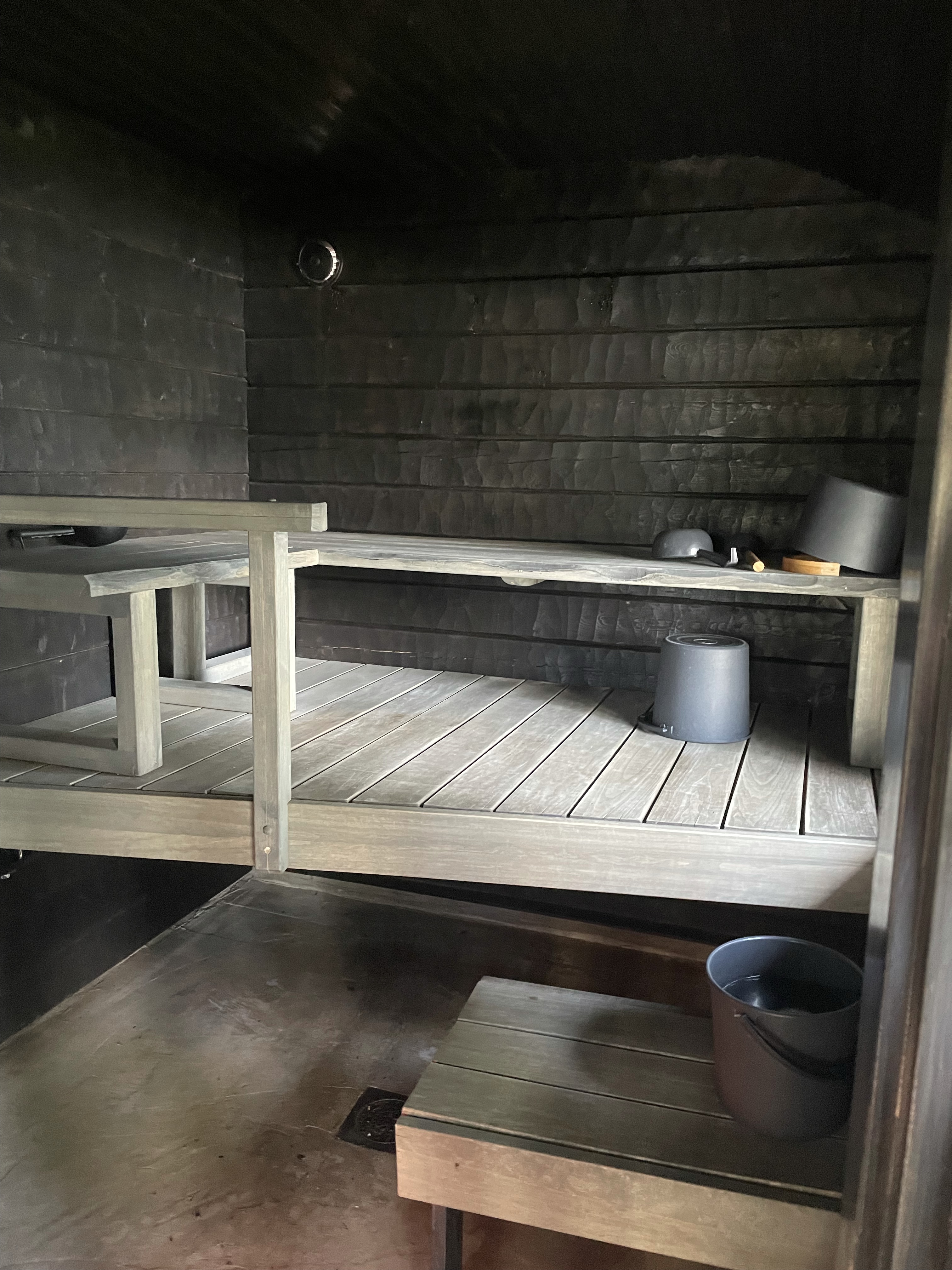
Cabin saunas are not always the best saunas in Finland. They surely are often idyllic and have a great location but many saunas made in the 60’s and 70’s are poorly ventilated and therefore the steam doesn’t flow as it should. I have always personally preferred sauna buildings made out of logs because they tend to breathe better. You still want to make sure that the draining and ventilation is well done. In the picture below, you can see one solution to bring fresh air in the room through an additional ventilation pipe. Small things like that can make a bit difference. In the same picture you see a typical floor in a Finnish sauna: sloped concrete and a drain. There is always a drain because we wash ourselves often in a sauna especially in winter. You don’t want to make that concrete floor and ice rink in winter or leave that water standing in summer.
How to experience a Finnish mökkisauna?
As with anything, if you know the right people you will always get the best travel experience. Many Finns like to keep their summer places quite private but many Finns also like to invite friends to their cabin. You can also rent these cabins in two ways. Firstly, many camping areas have cabin next to each other. Great choice if you want to hang out with strangers. There are also websites like huvila.net and lomarengas.fi to look up rental cabins that are sometimes more isolated and authentic. I’m sure there’s something on AirBnB and similar too.
Depending on the source, there are probably between 2-3 million saunas in Finland. The population is about 5.6 million and there are about 2.6 million household-dwelling units. So there are many saunas there.
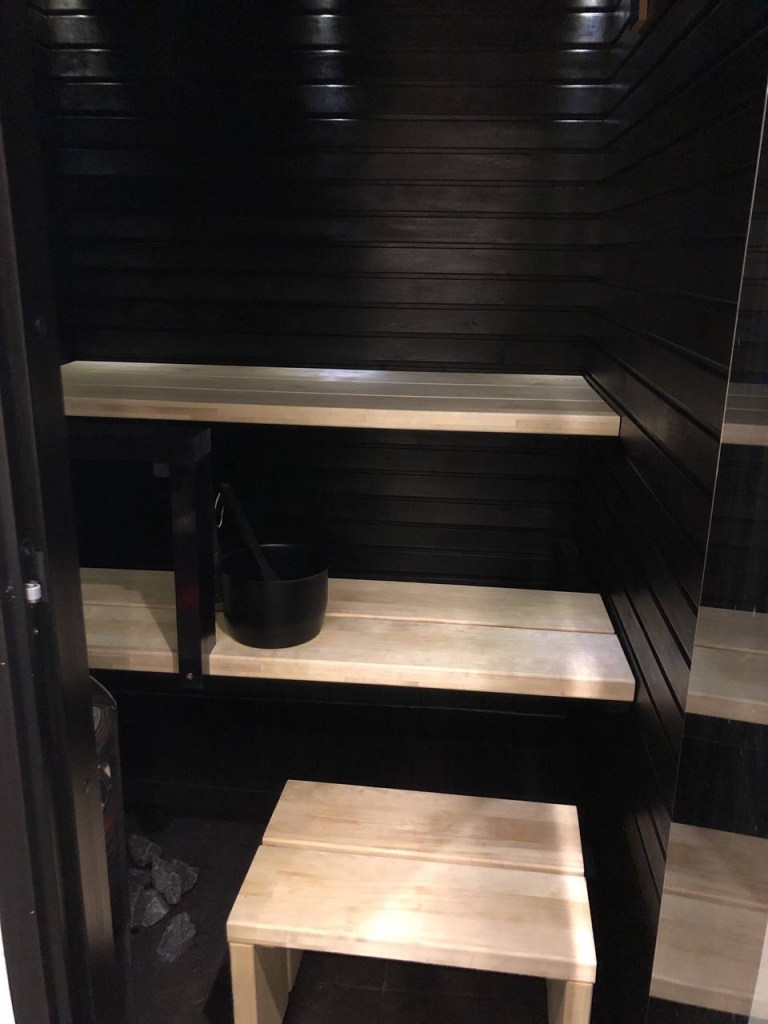
Saunas are quite typical even in condos and apartments. Many of those saunas are rather small and most if not all have electric stoves. Sometimes these saunas are frown upon by the locals because the air is considered often too dry and the steam is scorching. It is certainly very easy to ruin a small apartment sauna with an over-sized stove. However, if the steam room is big enough, there are ways to build very good saunas in apartments.
While most electric stoves are small and heated up about 45 minutes before going to sauna, there are also electric ”always on” alternatives available. While regular stoves typically have about 50 pounds of rocks on top, these keep about 200 pounds of rocks hot and ready to go in an insulated silo. The stove is always on and works a bit like a thermos bottle and the temperature in the isolated silo is kept at about 250°C (480°F). The steam room temperature stays a little above normal room temperature. When you are ready to go to sauna, you just open the latch and let the room heat up for a bit and enjoy. In ways, the main idea in this sauna actually gets pretty close to traditional smoke saunas. The stove will not be able to keep the rocks hot enough indefinitely but you cannot pour so much water either during one evening that you would run out of steam.
My brother happens to have one of these saunas so we decided not only to enjoy the gentle steam but also make a science blog of it.
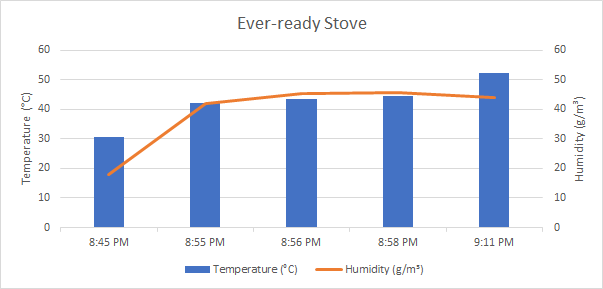
We started of by replacing the traditional sauna thermometer with a Ruuvi tag. When we started the session, the Ruuvi sensors showed only 30c temperature whereas that traditional showed about 20 degrees more. Most traditional sauna thermometers tend to show too high temperatures. The heat stratification is this kind of sauna is much less dramatic than in small electric saunas because these saunas are colder in general.
When we started the session, the sauna felt a bit cold. We could have left the latch open for a bit longer time before starting the session but I liked the idea of heating up the room with steam. A bit like how snow and tent saunas work in general.
The first pour of steam quickly more than doubles the humidity from 18g/m3 to 42 g/m3 and the temperature increased by 12°C immediately as the stove kicks some of that 200°C air to the steam room. The steam is very gentle and feels humid on the skin but not burning at all. Remember, this sauna is colder than what you are used to and that absolute humidity converts to about 73% relative humidity. It is hard to get anywhere near that in traditional saunas.
We did two sessions with a short break in between. The temperature eventually rose above 50°C and would have obviously risen higher if we did the third and fourth session. Absolute humidity stayed in the mid 40’s in g/m3. 200 pounds of rocks can generate a lot of steam so we had a pretty solid constant löyly in the room. At the end of the last round, the temperature was 52°C and absolute humidity was around 44 g/m3. This translates to about 48% relatively humidity. Still very humid and pleasant but it is just good to keep in mind that relatively humidity is generally a very poor metric in saunas.
One interesting finding was also that the dew point during our session remained at 36-38°C. It is quite easy to get the dew point to increase well above 40°C. At that point the steam from the sauna stove condenses on your skin so it feels like that you are sweating more when in reality you actually sweat less because that moisture doesn’t evaporate from your skin as easily which makes you sweat less. In any event, we did sweat a fair amount.
Conclusions
Overall, the ever-ready sauna was a different and a pleasant experience. I don’t see much value in having the stove always ready to go in minutes because most people can always wait for 45 minutes to get their sauna ready. However, the concept of 200 pounds of rocks is great and the steam is very gentle. Also, Finnish apartments are generally poorly air-conditioned so this kind of sauna is a great alternative there in summer to not to get the whole apartment too warm because of sauna. This kind of stove probably works the best for people that are not notoriously looking at the thermometer but rather enjoy smoke sauna like gentle steam.
I always wanted to know how much do I actually sweat in Sauna. Instead of Googling some generic answer, this mystery called for a science project.
Why do we sweat in sauna?
Very simple – the air temperature in a sauna is significantly higher than your body temperature. The air heats up your skin and muscles and expands the veins. The blood pressure decreases and your heart starts pumping blood faster so that you won’t faint. External heat and higher pulse together increase the body temperature.
Your system then tries to lower your body temperature back to 37°C. If you have enough water in your body, your system moves warm water on to your skin and that lowers the body temperature. The sweat is then supposed to evaporate but that’s where the Finns trick science. The evaporation won’t happen in a hot and humid sauna unless the temperature of the sweat on your skin raises above the dew point, which it won’t. Consequently, your skin temperature keeps going up to above 40°C and this will eventually increase your body temperature to maybe 37.5 – 38°C or even more.
So technically you have a fever-like condition in sauna. Some call it hyperthermia. This is another fascinating topic for another blog post but your body generally increases its temperature to ask you to calm down (a few other things happen too). This might explain why you feel relaxed in a sauna and will sleep better after. We can dive deeper on this later.
In any event, you are supposed to get hot in sauna and that will make you sweat.
Have you always sweat wrong?
As also explained in my previous Generating Perfect Löyly blog post, the main idea in sauna is to make you sweat. Some people firmly believe that the hotter the sauna, the better. While I understand that hotter sauna makes you sweat more, I still suggest that whether the sauna temperature is 70°C or 90°C does not really matter. This is because the steam that hits your body is anyway about 100°C regardless of how warm the sauna is. If the steam is hotter than the air, it feels about the same on your skin. However, the hotter the sauna, the drier the air so a 90°C sauna, especially an electric one, can be really uncomfortable.
If your sauna is above 100c, then the steam actually cools your sauna down (maybe) but let’s not go there. The main point is to use water in a sauna because the steam sensation feels better than hot air alone. The steam also increases humidity and makes the air more breathable because it accelerates ventilation, which takes both carbon dioxide and sweat smell out faster and replaces that bad air with fresh air. This is probably why some saunagoers feel tired is a dry sauna but will feel better once the löyly happens.
So my choice is always to heat up my electric sauna to about 65-75°C and then generate a lot of steam. When I add water on the stove, I get really sweaty immediately. Or do I?
What is dew point and why it matters?
Wikipedia says: “The dew point is the temperature to which air must be cooled to become saturated with water vapor. When cooled further, the airborne water vapor will condense to form liquid water. When air cools to its dew point through contact with a surface that is colder than the air, water will condense on the surface.”
So, if the dew point is, say 10°C in the air and the grass on your backyard is 5°C warm, water from air will condense on the grass. Similarly, if you bring a cold water bottle to the sauna, the bottle stars sweating because the bottle temperature is lower than the dew point in the air. This same works with a bottle of beer, by the way.
Dew point can be calculated if you know the air temperature and relative humidity. The easiest way to calculate is to Google “dew point calculator”. For reference, dew point is 41°C , if the air is 70°C and relative humidity is 25%.
Why this matters? It matters because löyly significantly increases humidity in your sauna as explained in the About Sauna Temperature and Humidity blog post. That in turn, increases the dew point significantly. The diagrams below demonstrate this in practice: when you pour water on the stove, the absolute humidity increases sharply. Obviously, the relative humidity increases as well because the steam doesn’t dramatically change the temperature. In my experiment below, the dew point went above 60c on the head level, which means that a lot of steam condensates to water on your skin because your skin temperature is much less.
So it looks like you are sweating a lot in sauna but you are actually just drying down the sauna air. If you had 300 ml water on your skin in sauna, some percentage of that is condensed vapor from the air and some portion is sweat.
To the lab!
I don’t always wear a towel in a sauna but when I do, it gets really wet and heavy. It also seems that the floor on my sauna is getting sweaty. My project was to find out, how much do I actually sweat in a sauna.
To measure this I measured my weight and then took the dry weight of all the towels I had. I then placed towels on sauna benches and floors so that they would absorb all the sweat and condensed water. After the sauna, I would just weight my body and those wet towels again and take the water consumed during the sauna into consideration.
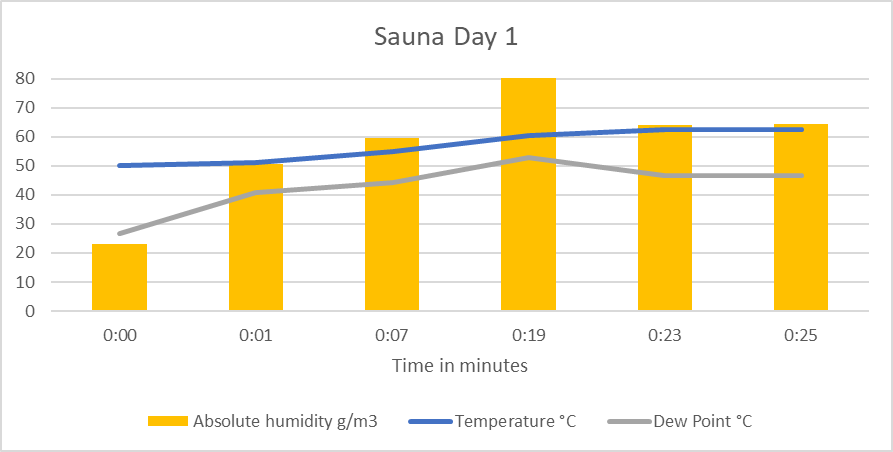
To make a perfectly believable study, I repeated my tests twice. The first time I only heated the sauna only to 50°C. It eventually warmed up to 65°C during the tests. The rocks were smoking hot. I did this to prove my point that the sauna temperature doesn’t matter as much if the rocks are about 200°C and you use plenty of water: vapor is still 100°C and when it hits your body you will sweat. The orange bar shows absolute humidity as I add water. Dew point increases as humidity and temperature increases. In the first session, the dew point exceeded 40°C and vapor started condensing on my skin. I did two 10-minute sessions with about 5-minute break.
After the second session I cooled down for about 5 minutes outside until I was not sweating anymore. Then I dried my curls and skin on those towels.
I drank 1.2 kg water (ok one water and two beers) and gained 600 grams weight. Thereby I sweat 600 grams or 600 milliliters. The towels gained 2.1 kg weight so they absorbed 1.5 kg moist sauna air. Therefore, only 29% of the “sweat” on my skin was actually sweat. 600 grams sweating is not a lot but this can be explained by unsually low temperature.
The next day I warmed the sauna a little bit more and started the session when it was 65c. I repeated two 10-minute sessions with about a five-minute break in between. Like the day before, there was about 70 grams water per cubic meter in the air but because the temperature was higher, the dew point was higher too.
This time, I dried myself immediately after the second session and weighted myself. This time, the result was 550g sweat and 1200g condensed water during the sauna session so about 31% of the “sweat” on my skin was actually sweat. However, I wanted to cool down and scale myself again 10 minutes after. Turns out that I sweat 500g more after the sauna session, which is quite a lot. It is easier for the body to sweat after sauna because the surrounding air is colder and less humid and the skin temperature decreases. So taking the cool down period into account, I could say that almost 50% of the water on my skin was sweat.
Other findings
I also measured the skin temperature on my arm during the session. It seemed that the temperature on the surface of the skin raised by about 5-7°C very quickly in a sauna. Some studies say that your skin temperature can increase by as much as 10°C in sauna. Fascinating data point.
Conclusions
I seem to sweat about 1 kg if I take two 10-minute sessions in a 70-75°C sauna and pour a normal amount of löyly.
Surprisingly lot of vapor condensates to water on my skin the sauna because the dew point rises to very high temperature in my barrel sauna.
My sauna keeps the steam in for quite long. If the löyly escaped from the vents quicker, the humidity would decrease quickly after löyly and less condensation would occur.
You probably won’t need this information for anything and I cannot give the reading time back to you. Sorrey, as the Canadians say.
First of all, I did not study physics after high school and I am by no means an expert in physics. However, the discussion of sauna temperature and humidity has been bothering me so I thought I try to explain a few basic things in a semi scientific way. This blog mentions the word löyly about 400 times. Löyly means the steam coming out of the stove when you pour water on the stove. I say when and not if. If you are not generating löyly, you are missing out.
As I mentioned in the Generating Perfect Löyly blog post, the sauna room temperature does not always correlate with the sauna experience because: 1. You are supposed to get warm and sweaty by gentle löyly. 2. The temperature highly depends on the type of your sauna. 215F feels about right in a smoke sauna but would be a torture in a small electric sauna. 3. Sauna thermometers and hygrometers usually suck. If you think your sauna is 200 degrees warm, check the thermometer first.
Another common question in forums is the humidity. Again, this is often measured by relative humidity. That in turn highly correlates with temperature so it is not a meaningful metric.
Science project begins
I have been wondering, why is the steam and the sauna experience actually very good in barrel saunas. These saunas break about every rule in the sauna rule book: they are small, often heated with an electric stove and you sit below the top of the stove whereas you are generally supposed to keep your feet at the same level with sauna rocks and rest of your body above that.
My sauna is a regular 4-person barrel sauna (Almost Heaven Pinnacle). I have introduced it in a separate Pöllä 3 Sauna blog post. It has a 6kW heater. The inside lenght is 160 cm (5 ft 4 in) and the inside barrel diameter is 175 cm (5 ft 10 in). So the volume is approximately 3.85 cubic meters. The rest of the blog is using metric system so bear with me.
I wanted to see if something weird happens with löyly in these saunas. What happens in löyly, stays in löyly.
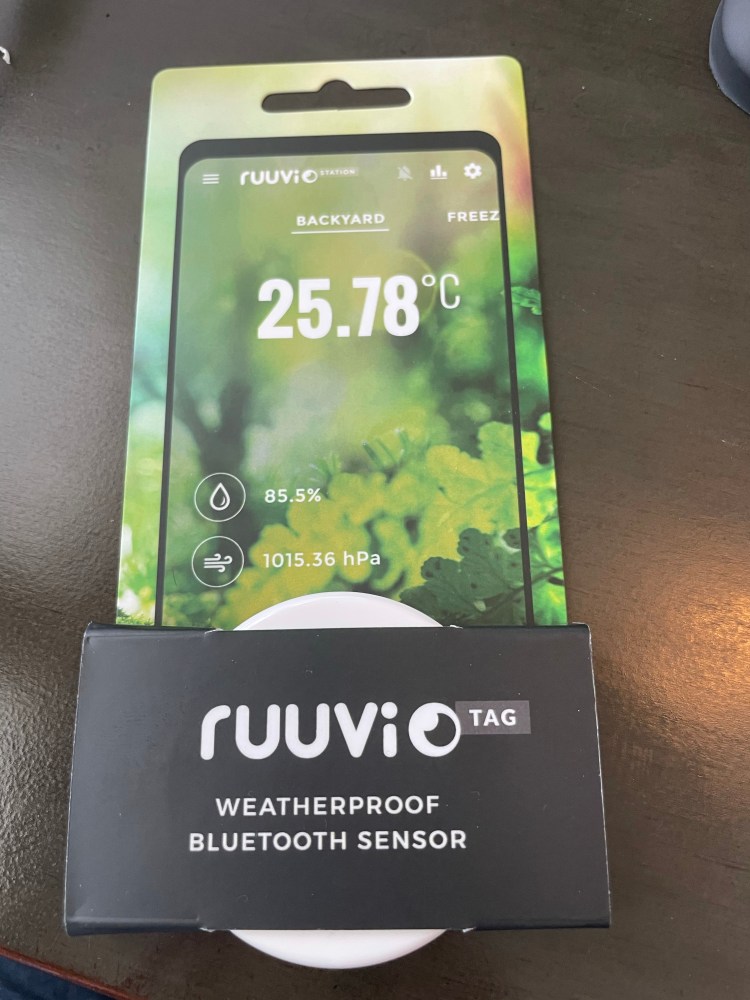
I found out about a Finnish startup Ruuvi (translates to a screw). They develop wireless bluetooth temperature and humidity sensors and their website talks about sauna as one use case for their product. The tag costs about 30 dollars and you can use it to alert on your phone when your sauna is warm. Wireless temperature tags are not novel but the fact that they promised the sensor to work at up to 85C is novel. They go even as far as selling custom lithium batteries that can bear higher temperatures. I thought this was a marketing gimmick but I could not find similar batteries from anywhere else. I guess I know what to bring back from Finland next time.
Anyway, finding a Finnish tech startup that mentions sauna as a use case was this “solution looks for a problem” moment to me. Shut up and take my money. Four sensors arrived in a few days from Finland to Texas with a hand-written note from the founder. Well done!
Ruuvi has a very simple app that allows you to record the readings with a smartphone and then save the log files as CSV for further analysis. The units store data locally for 10 days and you can download the dataset to your phone.
Sauna temperature
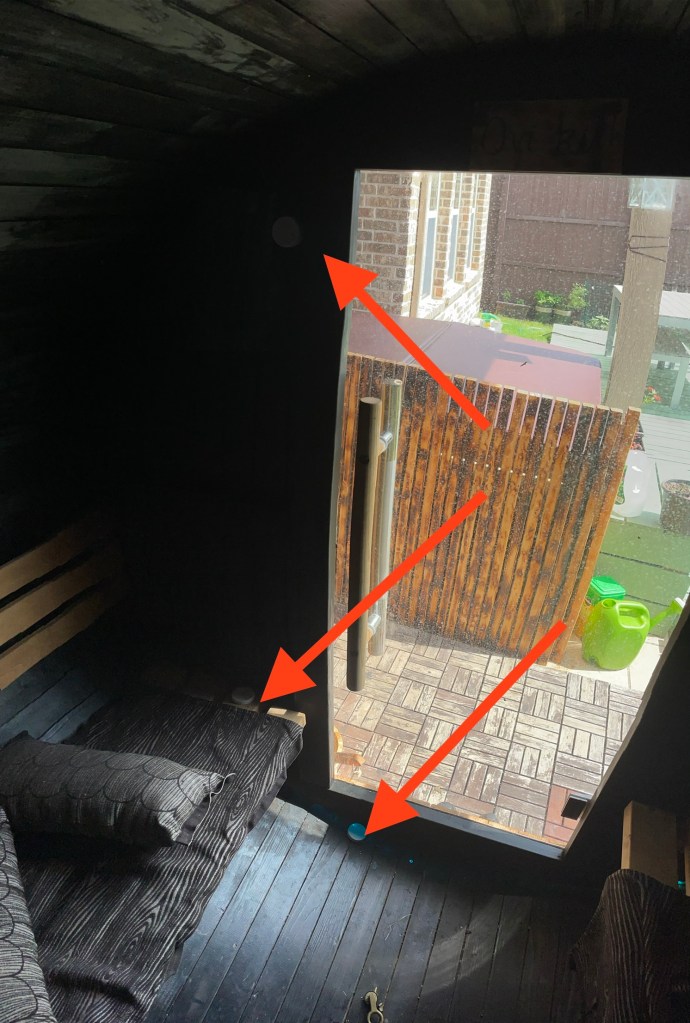
I placed three sensors in my sauna: one on the floor, one on the bench and one on the top.
I then heated up my sauna a bit warmer than usual. I usually go in when the temperature is in the 60’s in Celsius. This time, I started when the top sensor was showing 75c. The temperature on the bench was 53c and on the floor 38c. Btw, the regular sauna thermometer next to the top sensor showed 85c at this point. I always knew that meter sucked.
Quite dramatic 50% difference between the floor and the top. Why?
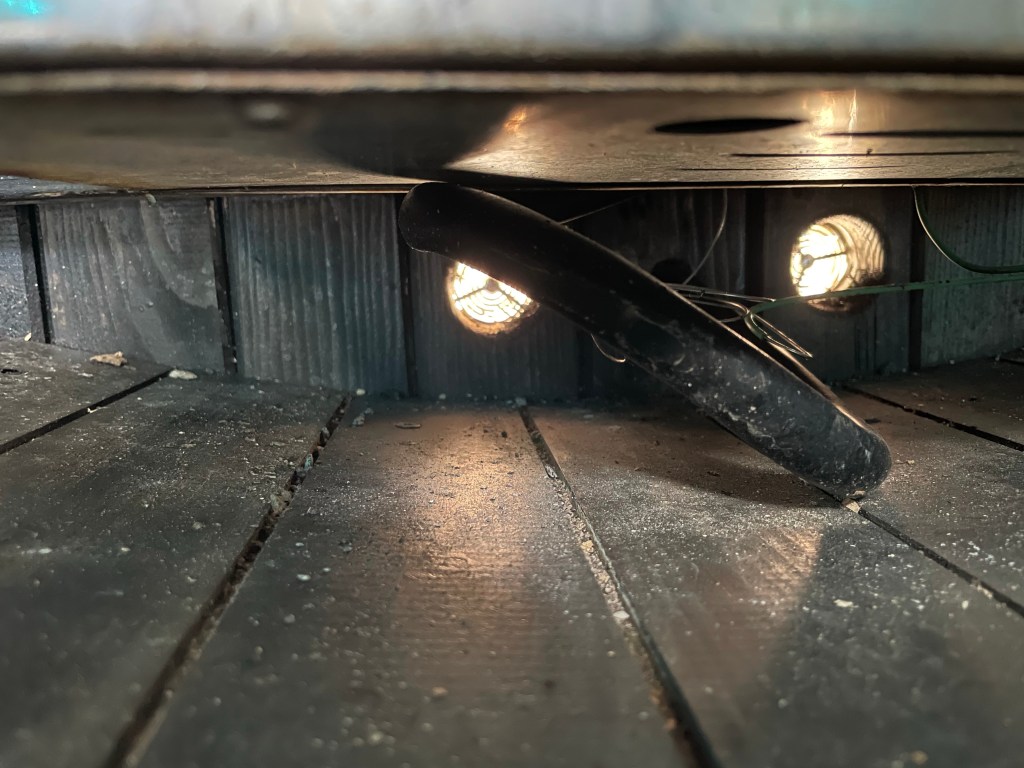
Hot air is lighter than cold air so hot air elevates to the top. Barrel saunas are small and the air circulates relatively well. The ventilation is based on the idea of having air vents below the stove. Warmer air escapes from the sauna via the top vent on the opposite side or from above the door (remember the The “Ovi Kii” Rule). This lowers the air pressure and creates a small vacuum that sucks new colder air from those vents. This is very simple yet brilliant mechanism that ensures that oxygen is added to the room and that sweaty smelly air escapes the room. You can control the flow by opening or closing the top vent on the wall. Another way to control the ventilation is to pour water on the stove.
Humidity
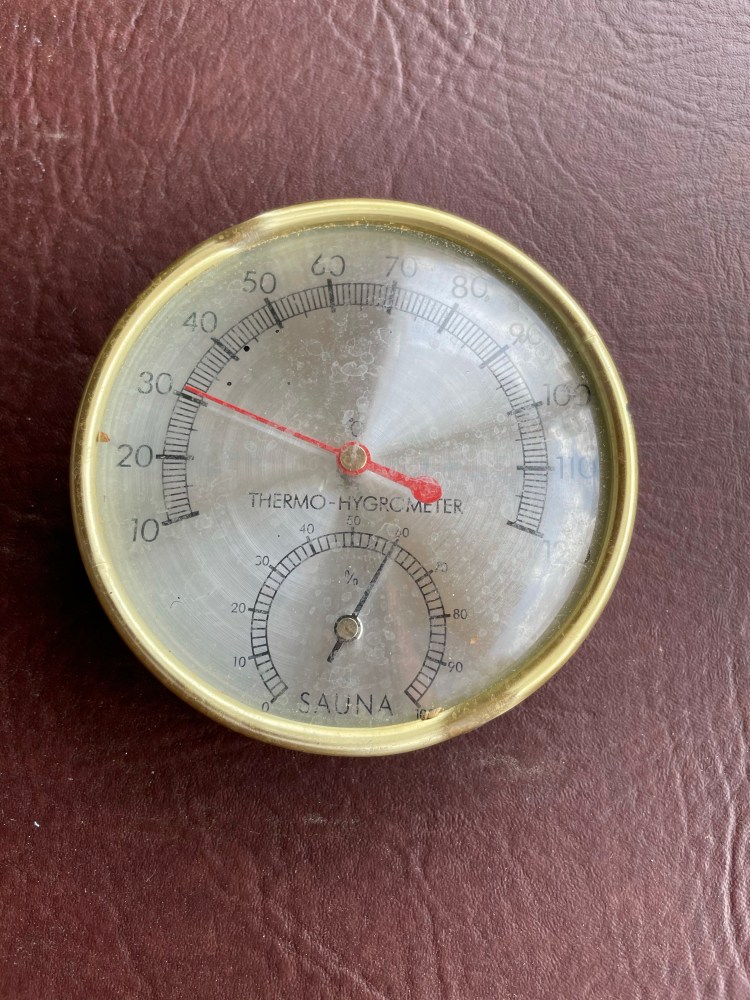
Is more humid air better in a Finnish sauna? Maybe because you are supposed to sweat. Is my sauna better than yours because my hygrometer shows 20% and yours shows 15%? Depends on two things: how accurate the hygrometers are and what is the temperature in each sauna. If you bought a toy meter like the one pictured on below, don’t even look at the meter. It shows 10-15% too high temperatures and hygrometer was about 300% off.
Most people refer to humidity via the relative humidity metric. The percentage tells you “the amount of water vapor present in air expressed as a percentage of the amount needed for saturation at the same temperature” (definition by Oxford Languages). This dew point increases as temperature increases. The correlation is very steep: if the air has 50 grams of vapor in a cubic meter, the relative humidity is 100% at 20c but less than 20% at 80c. 20% humid sauna at 80c has about the same amount of vapor it the air than 50% humid sauna at 60c.
Why would humidity matter then? Because that is the basic principle of löyly. You convert water from the bucket to vapor, which mixes with the air and hits your body and turns back to water again. And.that.feels.good.
Only a portion of that moisture on your body in sauna is actually your sweat. Most of it is that löyly that finds a colder element (like your heart) in a sauna and hits your body, your body cools the steam down and the steam converts back to water. This has to do with the dew point being very different on your 37c skin vs. 80c air. Fascinating topic and a good reason to learn Finnish is to read more about this in for example Saunologia.
What does löyly do to the temperature and humidity?
Common sense says that sauna gets warmer when you add steam to the room. It definitely feels so. People that read books could claim that this is not true because you the energy in the room stays the same: you move water from the bucket on the sauna rocks to the air. Temperature should not change. But does it?
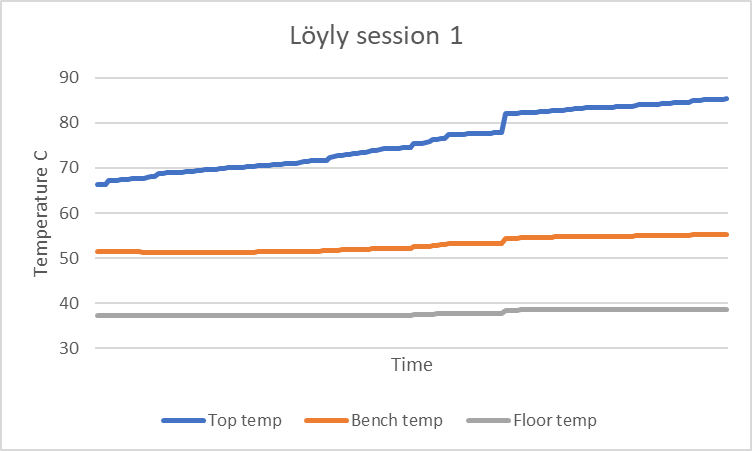
I started the session by pouring about 200-300 grams water on the stove. I then enjoyed the steam, waited for a while and added another 200 grams or so. The chart below shows how temperature kept increasing. Part of that was due to the stove being on but the change seemed to be accelerated as I added löyly. The graph below also highlights, how dramatically the humidity increases in a small sauna by adding a ladle of water. That was expected, right?
Another way to understand whether the steam actually increases sauna temperature is to look at the temperature changes in different sensors. Your can see that the temperature increases fastest during this löyly session on the top sensor so I’d say that löyly increases sauna temperature in the steam area (above the bench) if the bucket is on the floor.
Back to humidity. In the first chart, you could see how the humidity increased by adding water. At first, it may seem that my second löyly was weaker than the first one. During the first round, the humidity rapidly went from 5% to 17% and then to 22% as I added a bit more löyly. On the second time it went from 4% to 10% to 14%.
However the temperature in the first round was 70c and on the second round 80c so relative humidity is a poor metric for comparison. Let’s look at this through absolute humidity. The chart below shows that absolute humidity peaked at about 45 grams / m3 on both times. Now remember that my sauna is about 3.85 m3 big and I added maybe 200-300 grams of water on the stove. Some of that did not convert to steam and some steam escaped but the numbers sort of add up.
Another interesting thing to look at is “where does that löyly go” in a sauna. Again, vapor is about 100c warm (can be actually a bit warmer) so common sense says that it goes up because it is warmer than the air in my sauna. Because there are those vents under the sauna stove and because the opposite wall is not airtight, the steam travels to the top of the opposite wall. You can see this in the chart below that show absolute humidity on different sensors. Humidity on the floor doesn’t change, on the bench level it almost doubles and on the top it quadrupled.
Conclusions
I will continue my day job in IT and leave physics to someone else. Read saunologia for more scientific articles and the Finnish Tiede magazine forum.
The above sources are a good reason to learn Finnish
Sauna temperature doesn’t matter. Löyly is always about 100c and that gently pats your skin. Löyly is btw about 100c even if the sauna temperature is above 100c. A nice way to cool down
Relative humidity is very poor metric in sauna but more humid air generally feels better and the best humidifier is the ladle
You sweat much less in a sauna than you think. Most of that “sweat” on your skin is actually löyly that cools down on your relatively cold skin and converts back to water. You will still sweat a lot so stay hydrated. This topic is worth another blog post.
Sauna IoT is the new black – throw your old thermometers away and transform your life with a data-driven saunology.
Disclaimer: it really is not my fault if you burn yourself in sauna, if your sauna heater does not like water or if whatever happens in your sauna or outside of your sauna. Consider this page more like a place to read stories.
In the U.S., Finnish saunas are often referred to as dry saunas. That term could not be more misleading. Finnish saunas are not dry at all. Well, before someone “Karen’s out”, let’s clarify that the dry sauna by definition probably means that steam is not actively generated like in the Turkish “saunas” or more precisely Turkish steam rooms.
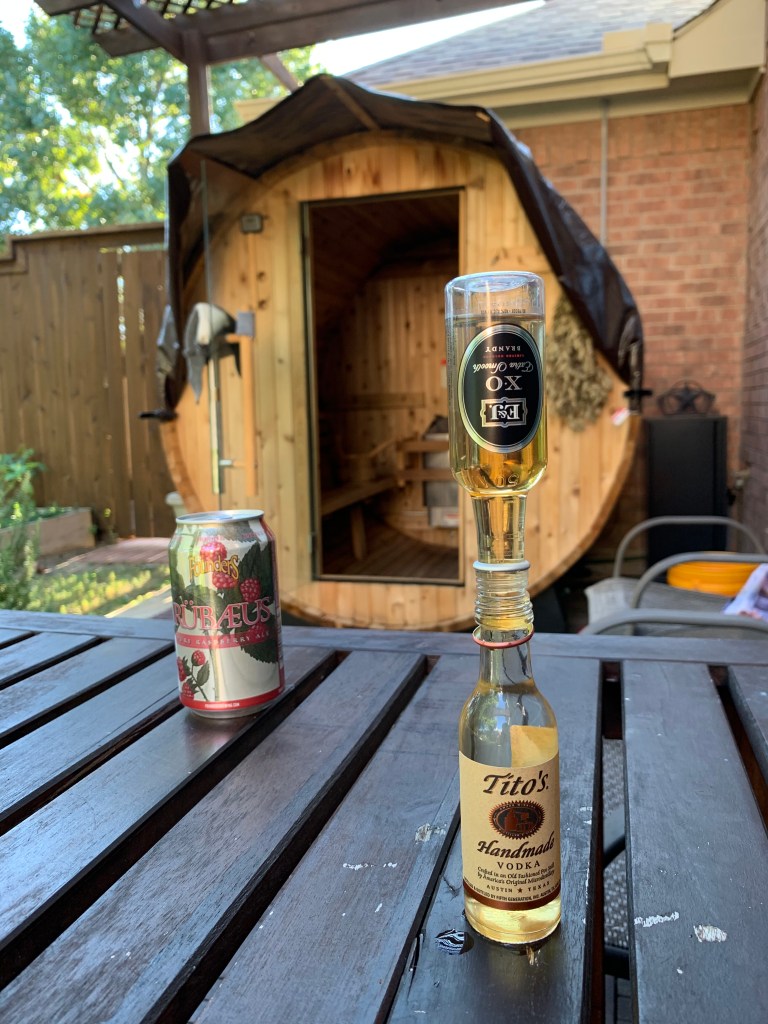
Now, Finnish saunas are wet or at minimum moist in two very different ways: steam is generated frequently and some people end up drinking a beer or two and maybe a tiny bit of Sauna-Jallu while relaxing in a hot room.
Sauna room temperature
I’ve seen many discussions in different online forums about ideal sauna room temperature. Some are firm believers that the room must be 195F (90C) or even hotter. My experience is that the room temperature actually matters very little. I usually go to my sauna when it’s at 140-155F (60-70C). But I bet I have also been in a tent sauna in winter and it was probably 40C max if that. It was still a great sauna.
The temperature doesn’t matter because you are supposed to get hot in a sauna by letting the steam hit your body nice and gentle. This magic is called löyly and it all boils down to getting the sauna rocks smoking hot. It literally boils down to that.
The Art of Generating Perfect Löyly
Generating steam in a sauna should not be very difficult at all. Simply pour water on a hot stove. Now, some people may be a bit anxious of doing that especially if they have electric heaters. While water and electricity aren’t the best buddies, keep in mind that the electric sauna stoves are based on the idea of heating up resistors (heat elements) that touch the rocks and heat the stones. Granted, these resistors seem to be metallic so you would think that you get an electric shock when you touch them, but no my friend, that is not really how they work. I can explain all this later in another blog post though. Anyway, sauna stoves can handle water.
While there are not completely f***ed up ways to generate löyly, common mistakes include the so called Finnish swim hall throwing technique where you throw water from 10 feet from the stove and hardly ever hit the rocks. Even if you do, the water will just quickly bounce off from the rocks and no proper steam is generated.
The secret is to very slowly pour water on the rocks and let the water dive deep in the stove. That generates a slowly approaching gentle steam. As for the water, use warm water if you can and never salty sea water or anything crazy. This pouring thing goes easier if you invest in pro bucket and a laddle that looks a bit like a coffee mug (see below).
If you want, you can add some scents like tar to your water.
Thanks for reading. Now watch this video and I will explain the very same stuff again. Repetitio mater studiorum est.
I bought my backyard sauna in 2019, after ten years of being a regular at Russian Banya of Dallas which was my first banya/sauna experience that left many nostalgic memories to me. Being born and grew up in South Korea where people have their own bath/sauna culture(it deserves a separate post by the way), I immediately fell in love with the steam. I would like to support the local business as much as possible, but the more I went there, the more it made sense to get my own. After checking quite a few hardware stores and sauna builders, I chose the easiest way: a barrel kit from Costco. I placed the order in April using up my father’s day gift chance a bit ahead of time.
Denis, my Russian buddy who introduced me to the Banya came over to help build the barrel along with my then-6 year old son. We started after lunch, taking enough time watching instruction videos and reading manuals, measuring and leveling the base, picking and rearranging boards for better fits as well as taking beer breaks from time to time, but we were still able to finish it around sunset without making a critical mistake. I heard from Denis about one of his friends who built the same model; he realized he had put the back panel upside down, but it was too late and he had to fill holes on top and put new holes on bottom. He can’t use it when it rains as he feels electricity. People, read the damn manual. Or drink less.
It was the best purchase of the year as I used it more than 100 times that year. If I did not buy it and kept going to Russian Banya 100 times, I would have spent more than what I paid for the barrel. It’s also more convenient for jallu drinking as the Banya does not allow BYOB anymore.
Korean way of making 2-star jallu
However, I knew my wife was still not too happy about it as she didn’t get that kind of expensive mother’s day gift. She is not a person who does revenge shopping either, so I still had to justify the purchase with some good reasons. Then the year 2020 came.
I had a business trip to Europe scheduled in March 2020 when the pandemic was just starting to become serious in the US and Europe. Right after I board on the flight to Europe, countries started closing borders and airlines canceling flights, and by the time I headed back to my Texas home after a week, all travelers coming from Europe were told to self-quarantine for two weeks. The virus was so unknown back then, I couldn’t afford to take any chances, so I decided to live in the barrel for two weeks, isolating myself even from my family. Working, eating and sleeping in the sauna was like being a caveman but still fun. And that’s when my wife eventually approved it.
Working from sauna
The pandemic lifestyle forced me to spend more time at home. There are always too many things at home to fix, improve and throw away. And I had this big beautiful wooden barrel. During the pandemic I was able to add some redneck engineering to it, such as an LED screen that displays the current time and temperature, remote switch and voice control, automations on the heater and vent, and so on. I barely have any advanced programming knowledge and I know my codes are ugly as hell, but hey, if it works, it ain’t stupid.
This tradition is probably quite obvious to the millions of Russian readers of this blog but I actually heard about this first time in my thirties when I visited Russian Banya in Carrollton for the first time and saw some Russian customers pouring tea from a samovar.
A Finnish man should never show any sign of hesitance regarding anything in a close proximity of a sauna so instead of finding out, why would someone in their right mind drink a hot drink while in a hot sauna or while trying to cool down between the sessions, I just decided to try this and it worked surprisingly well.
After thorough research (one Bing search and two Google searches), it turns out that the reason might be that the tea would make you sweat easier in sauna. I personally do not have any problems for not sweating in sauna. Another page explained that tea would help you to keep your body warm between the sauna sessions. That also sounds a bit counter-intuitive if you actually left the steam room to cool down. But as my good Russian friends always tell: in Russia nothing works but everything gets sorted out.
In any event, I sometimes enjoy a warm cup of tea between my sauna sessions just to keep this tradition alive, whether this tradition makes any sense or not. After all, traditions are not always supposed to make sense. It is generally a good idea to call something a tradition, if it actually doensn’t make sense or if you have already forgotten why you do something. Just because “we have always done this” is a legitimate reason for any action.
One pro tip to share is that tea is often very hot and you may easily pour too much honey in your cup. Luckily, the Russians have invented a perfect solution for this problem. It is another liquid made of potato and it works perfecly as a hybrid unsweetener and unburner-of-your-tongue solution that mixes well with tea. Ваше здоровье!
Let’s all admit, there’s something about cooking your sausage in a hot sauna. Kiuasmakkara (stove sausage) or saunamakkara is probably the most iconic food to cook in a sauna at least in Finland. Koreans have their famous sauna eggs. However, they are usually not cooked in a sauna. So let’s just say that kiuasmakkara is the food to cook in a sauna.
The procedure of cooking this delicacy is very simple: you just put sausage and onion slices in a grilling bag and pour 3-4 oz beer in the bag. Close the bag and place it on the heated stove and leave it on for about 20 minutes. You can go to sauna and pour water on the stove or on the aluminum bag. The bag won’t care, it doesn’t have feelings. After 20 minutes, carefully remove the bag using oven mittens (yes, aluminum tends to get hot on sauna stove), open the bag and enjoy with mustard (Turun Sinappi).
As for the raw material, HK Sininen would be the only acceptable choice in Finland. However, when abroad, you have to improvise. HK Sininen taste and texture is similar to Bologna sausage and our experienced science group has tried it (see the video below). It is a great alternative. I am not suggesting that it is the best tasting kiuasmakkara but it gets close to HK Sininen.
https://kubys.com/Other great alternatives include German style wiener sausages (wiener wurst) or “knackwurst”, which are both most often pork meat based. In Dallas, the best alternative I have found are Prinskorv that I have found at Wooden Spoon in Plano and Wienerwurst and Knackwurst sold by Kuby’s.
Most regular hot dog wieners are made of beef so they won’t be ideal. Kiuasmakkara must be fatty, floury and pork meat based. Another reasonable option could be Meica Deutschländer but Mein Gott, don’t spend $35 on this via the provided rip off link. If you have an international supermarket of some kind in your neighborhood, that’s a good place to start.





















 Hakka-Sauna